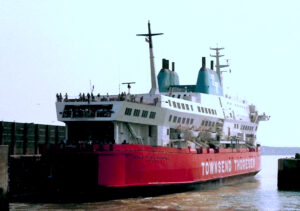
On the evening of 6 March 1987, the Herald of Free Enterprise, one of three Spirit-class ferries operated by Townsend Thoresen, left Zeebrugge fully loaded and bound for Dover. Just over twenty minutes later, shortly after passing the harbour’s outer mole, she capsized, eventually claiming the lives of 193 passengers and crew.
The immediate cause could hardly have been more prosaic—or more merciless. The crew had failed to close the enormous bow doors through which vehicles entered and left the car deck. Once the ship cleared the harbour and began gaining speed, vast quantities of water poured onto the deck. Within minutes, the ferry was lying on her side. Only the shallow water and a fortunate sandbank prevented her from disappearing completely beneath the surface.
There was little dispute about the immediate cause: the bow doors had been left open. Identifying who was responsible, however, turned out to be a much more complicated exercise—one that would ultimately lead to important changes in maritime safety and, more broadly, to the way human error is understood.
The first suspect appeared rather quickly.
Closing the bow doors before departure was the responsibility of the assistant bosun, Mark Stanley. Shortly before sailing, Stanley went down to his cabin for a short break. He fell asleep and was still asleep when the ship dropped her moorings.
So the investigation was clearly dealing with human error, and the human in question seemed obvious: Stanley had overslept an important duty.
Case closed?
Happily, the investigators did not stop there.
They discovered that this was not the first time something remarkably similar had happened. In 1983, another ferry belonging to the same company—the Pride of Free Enterprise—had sailed with its doors open after another assistant bosun had fallen asleep. On that occasion the mistake was noticed in time and disaster was avoided. There had, in fact, been several previous occasions on which company vessels had gone to sea with bow or stern doors open.
At that point, blaming one sleepy junior crew member began to look less satisfactory. Passenger ferries should not be capable of sinking simply because one tired person fails to wake up at the right moment.
There is another detail worth remembering about Stanley. After the capsize, despite being injured, he returned to help rescue passengers trapped inside the vessel until cold and blood loss forced him to stop. The man whose mistake helped trigger the disaster was also capable, minutes later, of considerable courage.
Human beings are inconveniently complicated like that.
So the investigation moved one step further up the chain of command, to Stanley’s superior: Chief Officer Leslie Sabel.
Sabel had responsibility for ensuring that the bow doors were closed. He had been on the vehicle deck, but left shortly before departure without actually seeing them shut.
Surely that qualified as serious negligence and a clear failure of duty?
It did. But again, the answer was not quite complete.
Another set of company instructions could require the same officer to be on the bridge before departure while his loading duties still kept him on the vehicle deck. The inquiry itself recognised that this created a conflict between his responsibilities. At the same time, officers were under considerable pressure to get the ferries away promptly once loading was finished.
Most of the time, of course, everything worked. The officer left the deck, somebody closed the doors, and the ship sailed safely. Nothing terrible happened.
And repetition has a remarkable ability to make an unsafe practice feel perfectly normal.
So responsibility moved another step upwards.
The captain was ultimately responsible for the safe departure of the vessel. Surely it was his duty to recognise the dangerous situation and stop the ship before it left harbour.
Sadly, not this time.
The captain could not see the bow doors from the bridge. Nor was there any indicator or other visual cue telling him whether they were open or closed.
There was something else too.
Townsend Thoresen’s standing orders effectively operated on a system of negative reporting: if nobody reported a deficiency, the Master could assume that the vessel was ready for sea.
And that was exactly what he did.
The inquiry still found the captain negligent. But it also noted that other masters were using essentially the same defective system, and that previous incidents involving open doors had not been communicated adequately to them.
So the investigation moved further again—to the people who had designed and managed that system.
Why should a safety-critical operation rely on the principle that “no news means everything is safe”? Why wasn’t there a simple “DOOR OPEN” light on the bridge? The problem hardly called for cutting-edge technology.
And why had no effective lesson been learned from earlier incidents?
The lessons certainly had opportunities to be learned.
As early as 1985, one of the company’s captains had specifically proposed fitting indicator lights on the bridge so that officers could see whether the bow doors were closed. The suggestion was circulated within management, but dismissed. One response even questioned whether an indicator was really necessary when someone was already being paid to close the doors.
The inquiry later concluded that, had the proposal received proper consideration, the disaster might well have been prevented.
By now, the picture looked very different from the one we started with.
Stanley had made a mistake. Sabel had failed in his responsibilities. The captain had departed without knowing for certain that the vessel was secured. Procedures had allowed conflicting duties and unsafe assumptions to become routine. Management had received warning signs and opportunities for improvement but had failed to act on them.
None of those discoveries made the previous failures disappear. They simply showed that stopping at any one of them would have produced an incomplete explanation.
The official inquiry ultimately reached much the same conclusion. Having examined the actions of the crew, it found itself led inexorably further up the organisation, eventually describing the company as suffering, “from top to bottom”, from a “disease of sloppiness”.
The subsequent criminal proceedings revealed another interesting problem.
Company managers were prosecuted for gross negligence manslaughter, and the operating company itself was charged with corporate manslaughter. The prosecution ultimately failed. At the time, English law struggled to deal with exactly this kind of distributed organisational responsibility: to convict a company, the prosecution effectively needed to identify a sufficiently senior individual whose personal gross negligence could be treated as the negligence of the company itself.
The evidence pointed towards failures spread throughout an organisation, while the law was still searching for one sufficiently important human being to pin them on.
The Herald of Free Enterprise teaches many lessons, but perhaps one of the most important is about the way we think about human fallibility.
Human beings make mistakes. We become tired. We lose concentration. We overlook things, make poor judgements, misunderstand instructions and occasionally behave negligently. These weaknesses are as inseparable from us as the better aspects of human nature—kindness, courage, compassion, self-sacrifice and love.
Accepting our fallibility, studying it and designing the way we live and work around it will take us towards a safer world far more effectively than treating every mistake as an opportunity for blame or humiliation.
That does not mean removing personal responsibility. Stanley was responsible for failing to close the doors. Sabel was responsible for leaving without ensuring that they were closed. The captain carried his own responsibility, and management carried theirs.
Understanding why somebody made a mistake does not make the mistake disappear.
But neither should identifying one mistake bring the investigation to an end.
Thanks to investigators who resisted the temptation to stop when they reached an easy answer—and then resisted it again when they reached the next one—the Herald of Free Enterprise became an important case in the development of maritime safety and in our understanding of organisational failure.
Would any of that have happened if the inquiry had assigned one hundred percent of the blame to the sleeping assistant bosun?