
Last time, while talking about the golden principle of good design, we mentioned one little detail that I would like to look at more closely.
I’m talking about this:
More than half of motorists would fail a theory test if they retook it today.
That is actually true: according to official figures, 55% of motorists would fail their theory test if they took it today.
Let’s resist the temptation to judge them immediately and instead focus on what this tells us in the context of design. (And if you are strongly in favour of judging, remember that risky behaviour is an incomparably greater contributor to serious and fatal road accidents than poor knowledge of the Highway Code.)
One thing we can conclude is that it would not be sensible to design our roads based solely on what the Highway Code says. If we know that the majority of drivers are somewhat shaky on the rules, then building a straightforward junction that relies entirely on those rules — for example, by painting the necessary road markings and putting up priority signs — is obviously not enough to make it safe.
Such a junction might comply perfectly with traffic law, but that does not guarantee that it will serve road users well by being efficient and safe.
This simple fact was understood many years ago, which is why today’s roads are much more than strips of tarmac accompanied by traffic signs. Modern road infrastructure has increasingly shifted from simply expecting drivers to follow rules written for them towards nudging them in the right direction through carefully designed road layouts.
Consider this road junction:
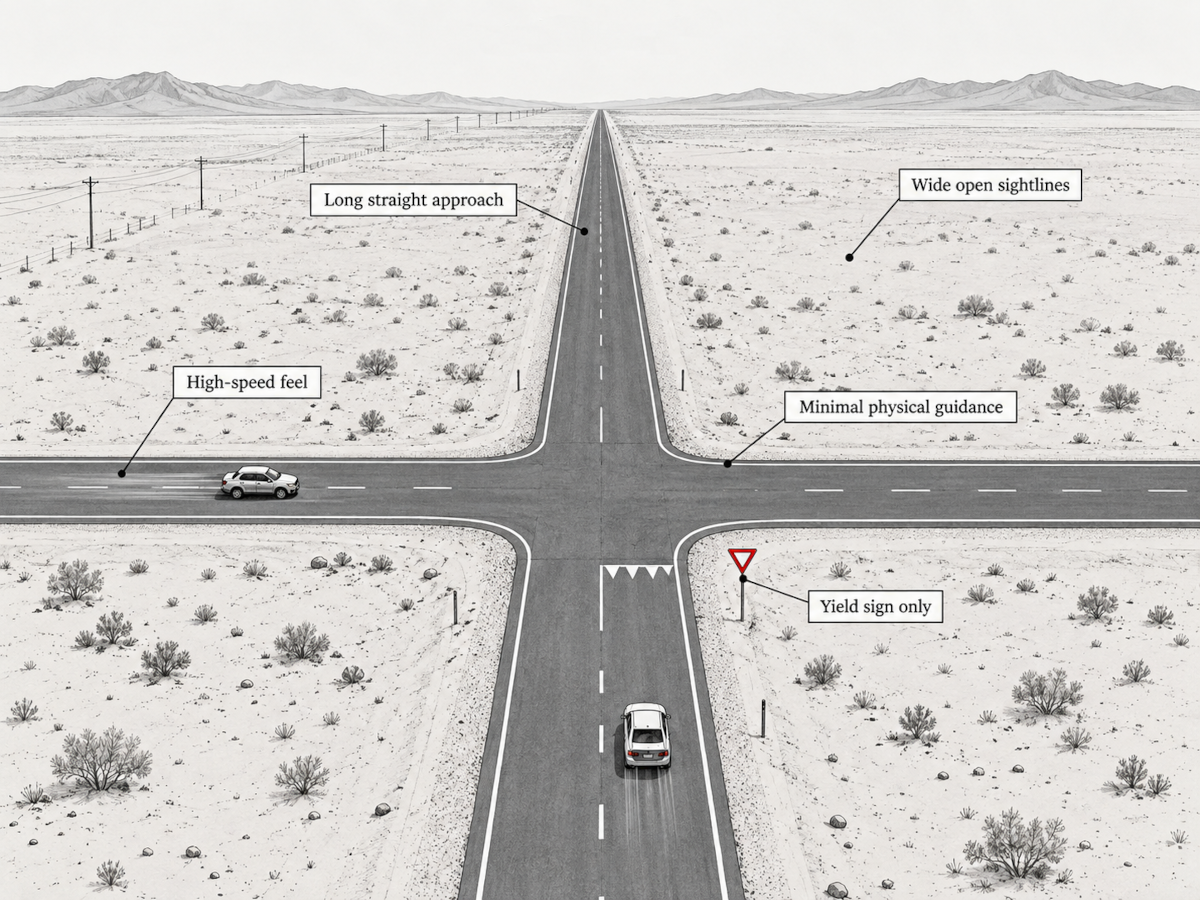
From the Highway Code perspective, it is a perfectly constructed junction. Well-equipped with road markings and traffic signs, it looks quite on par with your average rural junction, and certainly beats a lot of junctions in less prosperous neighbourhoods and countries, where road markings are often a luxury.
Thing is, junctions like the one above are responsible for enormous amounts of deadly crashes. The labels tell why.
A way better equivalent is shown below:
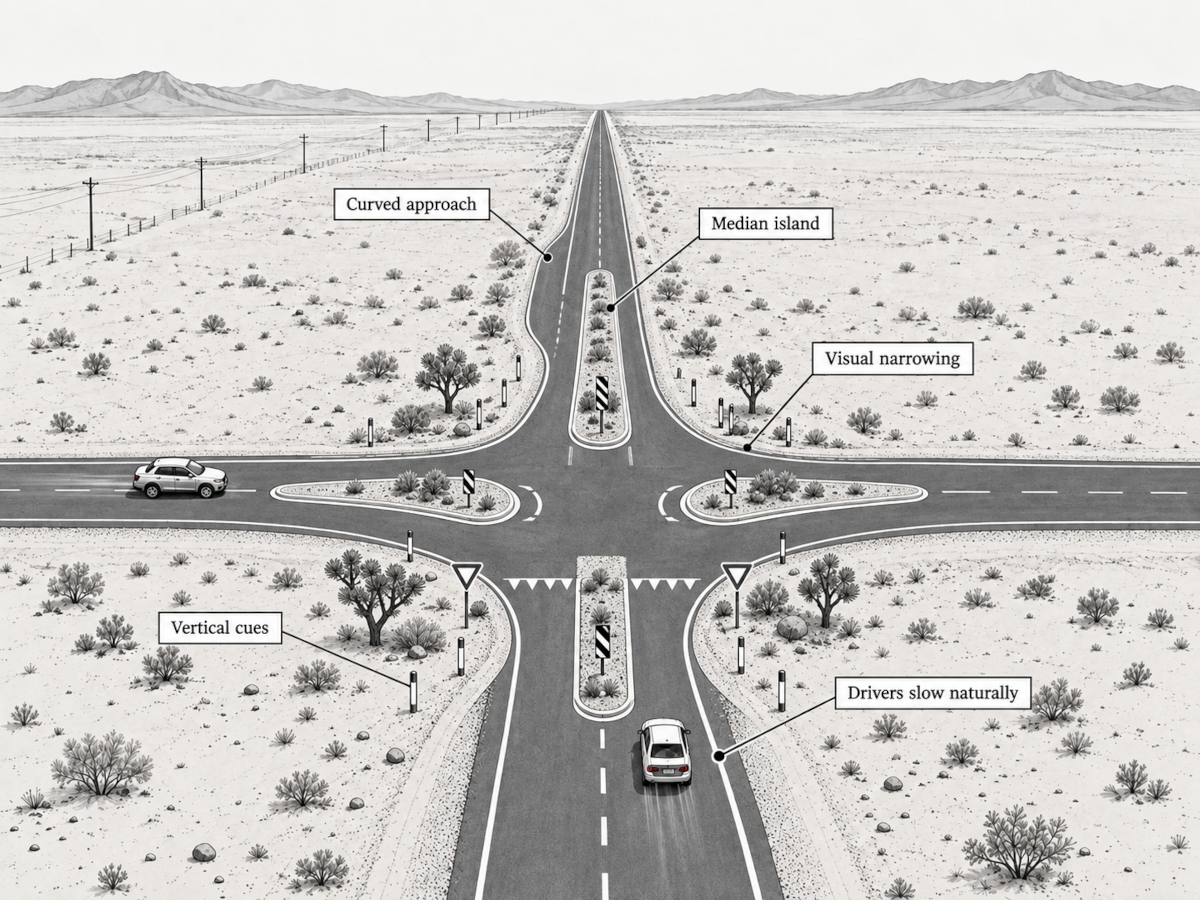
It still perfectly complies with the Highway Code, but it also does something else — it treats humans as humans, and not undistractable, observant, flawless law-abiding robots. This junction is a holistic structure, every piece of which – from the safety islands in the middle of the carriageway, to repeated give way signs, to intentional narrowing and curving, force the driver into slowing down and navigating the intersection with care.
Safety-focused road infrastructure is one example of an effective resolution to the Law vs. the Beaten Path dilemma.
Most parts of our gigantic system — driving included — are governed by laws or sets of written rules designed to organise and clarify how that part of the system should work. What is important to understand is that those rules do not always support reality as effectively as they could. The Highway Code creates rules that are supposed to make our road safe, but are they really that efficient if less than a half of road users can use them confidently enough?
Blaming an accident on a driver who failed to navigate a junction safely because of gaps in her knowledge of the Highway Code is easy. Legally, that assessment may be perfectly correct. But in the long run, it does little to make driving easier or our roads safer.
It is the designer’s job to identify situations in which formal rules are not doing enough to support what actually happens on the ground. As we learned in the previous post, the designer’s ultimate goal is to create things that increase the overall value of the environment we live in, rather than merely address the specific problem immediately in front of them.
That includes the willingness and ability to identify rules that are not working well enough and, when necessary, to shape the environment so that users are naturally encouraged to follow those rules — rather than simply punishing them when they do not.