
The Law vs. the Beaten Path: And, Not Or

Last time, while talking about the golden principle of good design, we mentioned one little detail that I would like to look at more closely.

I’m talking about this:

More than half of motorists would fail a theory test if they retook it today.

That is actually true: according to official figures, 55% of motorists would fail their theory test if they took it today.

Let’s resist the temptation to judge them immediately and instead focus on what this tells us in the context of design. (And if you are strongly in favour of judging, remember that risky behaviour is an incomparably greater contributor to serious and fatal road accidents than poor knowledge of the Highway Code.)

One thing we can conclude is that it would not be sensible to design our roads based solely on what the Highway Code says. If we know that the majority of drivers are somewhat shaky on the rules, then building a straightforward junction that relies entirely on those rules — for example, by painting the necessary road markings and putting up priority signs — is obviously not enough to make it safe.

Such a junction might comply perfectly with traffic law, but that does not guarantee that it will serve road users well by being efficient and safe.

This simple fact was understood many years ago, which is why today’s roads are much more than strips of tarmac accompanied by traffic signs. Modern road infrastructure has increasingly shifted from simply expecting drivers to follow rules written for them towards nudging them in the right direction through carefully designed road layouts.

Consider this road junction:
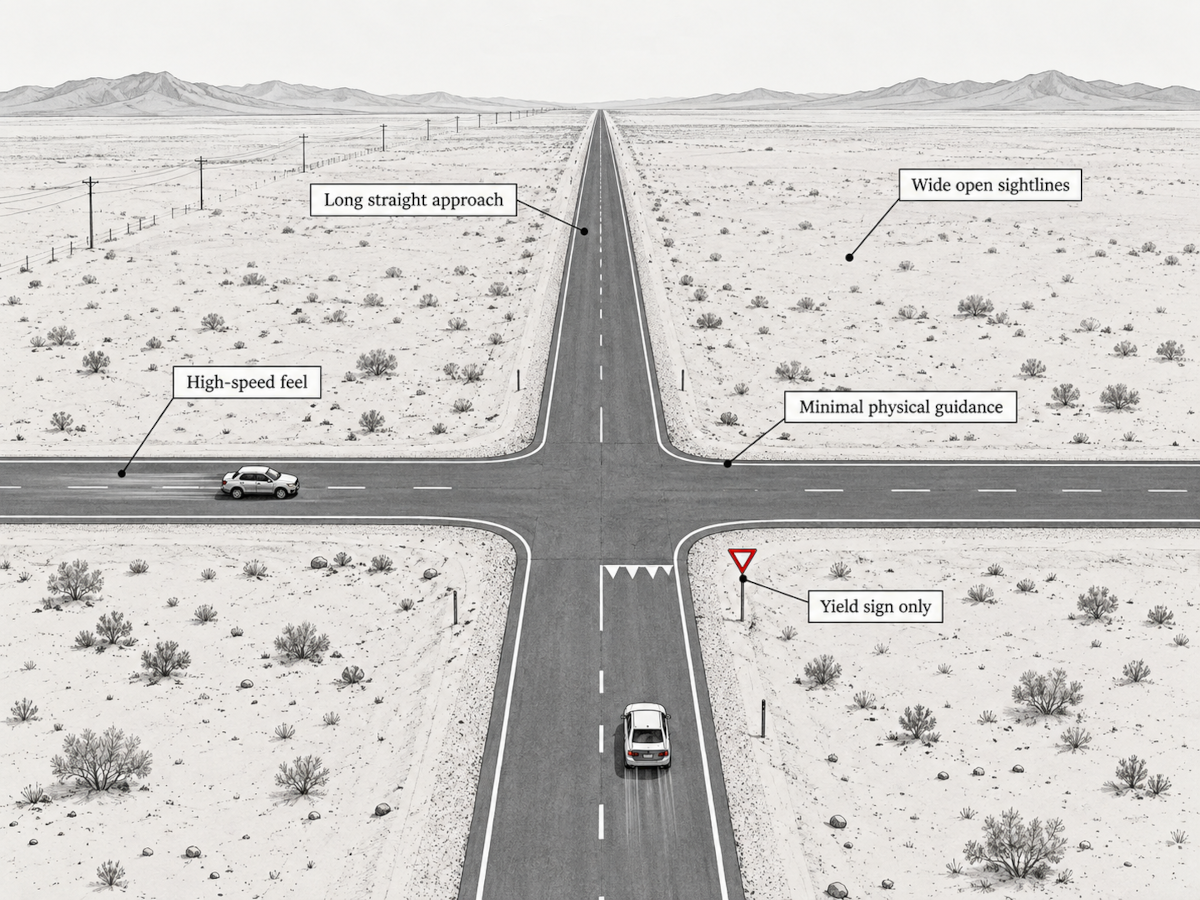
From the Highway Code perspective, it is a perfectly constructed junction. Well-equipped with road markings and traffic signs, it looks quite on par with your average rural junction, and certainly beats a lot of junctions in less prosperous neighbourhoods and countries, where road markings are often a luxury.

Thing is, junctions like the one above are responsible for enormous amounts of deadly crashes. The labels tell why.

A way better equivalent is shown below:
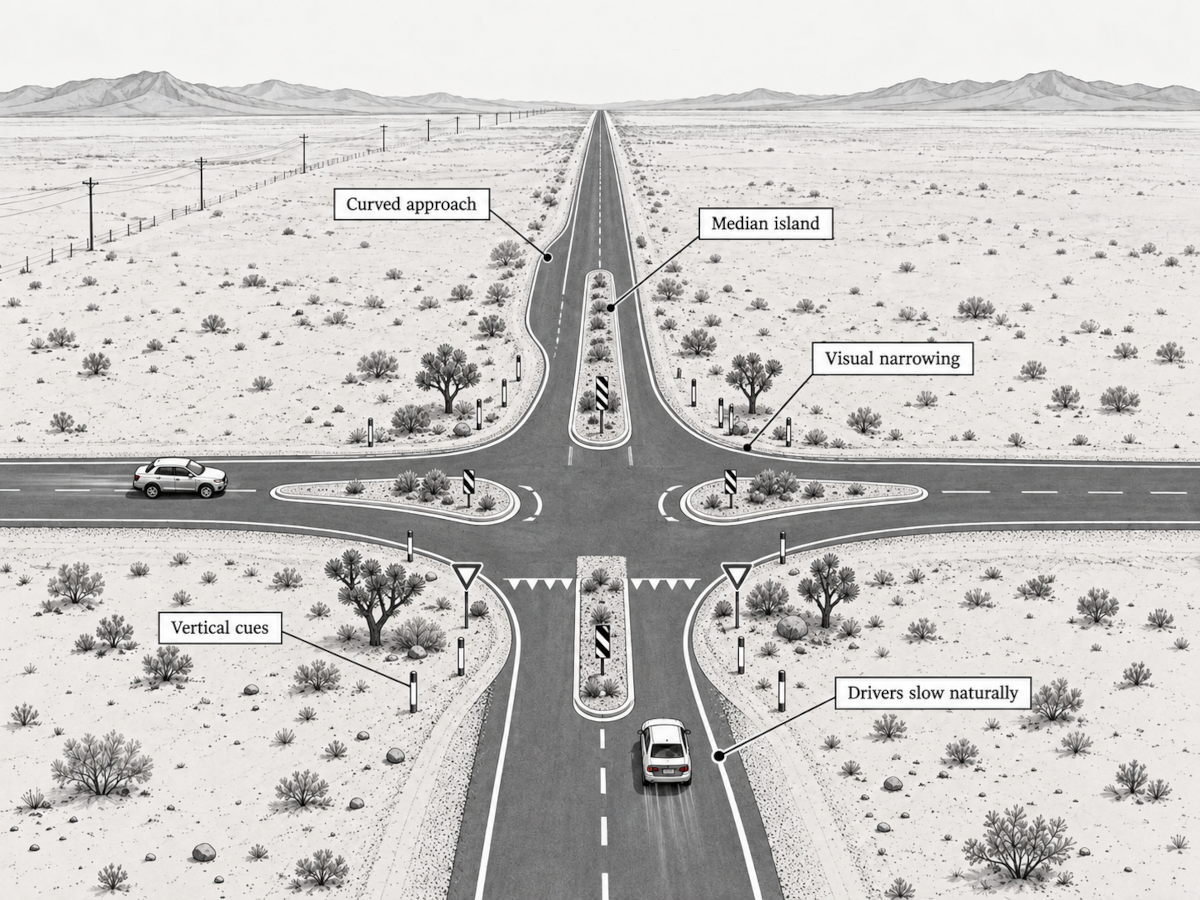
It still perfectly complies with the Highway Code, but it also does something else — it treats humans as humans, and not undistractable, observant, flawless law-abiding robots. This junction is a holistic structure, every piece of which – from the safety islands in the middle of the carriageway, to repeated give way signs, to intentional narrowing and curving, force the driver into slowing down and navigating the intersection with care.

Safety-focused road infrastructure is one example of an effective resolution to the Law vs. the Beaten Path dilemma.

Most parts of our gigantic system — driving included — are governed by laws or sets of written rules designed to organise and clarify how that part of the system should work. What is important to understand is that those rules do not always support reality as effectively as they could. The Highway Code creates rules that are supposed to make our road safe, but are they really that efficient if less than a half of road users can use them confidently enough?

Blaming an accident on a driver who failed to navigate a junction safely because of gaps in her knowledge of the Highway Code is easy. Legally, that assessment may be perfectly correct. But in the long run, it does little to make driving easier or our roads safer.

It is the designer’s job to identify situations in which formal rules are not doing enough to support what actually happens on the ground. As we learned in the previous post, the designer’s ultimate goal is to create things that increase the overall value of the environment we live in, rather than merely address the specific problem immediately in front of them.

That includes the willingness and ability to identify rules that are not working well enough and, when necessary, to shape the environment so that users are naturally encouraged to follow those rules — rather than simply punishing them when they do not.

The Golden Principle

The case of the Herald of Free Enterprise can teach us one curious investigative technique that can be particularly helpful in identifying culprits in cases of human error. But let’s first take a short break from human fallibility. Picking apart someone’s bad design decisions is as easy as it is untimely: what’s done is done, and the best we can do once the flaws reveal themselves is learn from mistakes that have already happened.

Let’s instead ask ourselves this: what distinguishes a well-designed system or product from a bad one? Why do some products become known as models of reliability and efficiency, whereas others — often quite similar at first glance — seem almost built to attract problems? What can we do at the planning stage to ensure that whatever comes off our drawing board becomes a safe and efficient product or workflow?

If I had to pick one key principle of good design above all others, it would be this:

Good design fits the system instead of forcing the system to fit it.

Look around. Our world consists of a multitude of processes that operate reliably and sustainably around us every single day:

The Sun rises in the east and sets in the west.

Gravity pulls objects towards the ground.

Weather follows recurring patterns, both short-term (clear weather gives way to overcast conditions and then clears again), long-term (warmer in summer, cooler in winter), and very long-term (El Niño and La Niña).

Plants and animals grow and thrive in favourable conditions and decline in unfavourable ones, both as individual organisms and as species.

Social life is subject to similar patterns:

People wake up in the morning and go to bed in the evening, becoming increasingly tired as the day progresses.

Most people in WEIRD countries are motivated by status and recognition, social affiliation, and comfort and security.

Most Westerners form nuclear households with one or two children and live independently of their own parents.

In certain societies, families extend beyond nuclear boundaries, with multiple generations and more distant relatives heavily involved in one another’s lives.

Most people navigate supermarkets counterclockwise.

More than half of motorists would fail a theory test if they retook it today.

Learning new things requires mental effort. Using familiar things doesn’t.

Most individuals, groups, organisations, towns, and countries develop sets of rules and patterns of behaviour that they follow in day-to-day life. Whether you call them laws, policies, cultural norms, routines, or rules of thumb, they are mechanisms people rely on to function efficiently and contentedly.

All these processes — physical, biological, social, and many others — come together to form one enormous system. Every one of us operates both with and within that system, relying on mechanisms that are already part of it.

Whenever you set out to design an object, a process, or a system, you are effectively inserting a new element into that colossal arrangement of gears, levers, and wheels. The element you introduce will inevitably change the system in some way: it may squeeze between gears, make some levers move more smoothly, or cause some wheels to turn faster. Or perhaps it will cause gears to lose contact with one another or make the levers too heavy. It may even produce excess heat, making neighbouring components too hot to touch.

The effect will vary, but there will always be one. A poorly engineered element, or one inserted in the wrong place, may cause wheels to spin aimlessly, wasting energy. It may introduce friction between gears that previously turned smoothly. Another may make no observable difference at all, simply sitting there, consuming resources and complicating maintenance.

A well-designed and carefully positioned element, on the other hand, can make the whole system work better. It might replace a dozen pairs of gears with one cleverly positioned pair, reducing both time and energy costs. It might adjust a faulty wheel ever so slightly so that it no longer throws sparks against the wheel beside it. Or it might make use of heat already produced by a steam engine, using that heat both to power itself and to dispose of excess thermal energy.

The point is that a well-designed object, system, or workflow increases the overall value of the larger system by integrating smoothly into it rather than demanding that the system make allowances for it. It takes something from the system and gives something back, but the net result of that interaction is positive.

That positive net result is the value your product introduces: it improves the system and, as a consequence, creates a sustainable reward.

Poorly designed objects, by contrast, obstruct the system’s existing processes and take from it without giving enough back. Even if they generate some value in isolation, that value may be offset by making the wider system slower, more expensive, or less reliable. Such objects can produce short-term benefits for some people, but they are unlikely to be sustainable in the long run.

Compare these two automotive designs:

An internal combustion engine produces hot exhaust gas. The manufacturer installs a cooling fan next to the exhaust manifold to cool the gas and prevent damage to nearby plastic components. The fan consumes electrical energy supplied by the alternator, which in turn receives mechanical energy from the engine through a belt.

Now imagine instead that the manufacturer installs a turbocharger that extracts energy from the exhaust to produce additional power, or channels that energy through a thermoelectric generator to produce electricity for the vehicle’s electronics. In the process, the exhaust gas gives up some of its energy and cools naturally.

The first design spends energy to fight an undesirable aspect of the system. The second design adopts and embraces that aspect, getting rid of it through a natural process and acquiring energy as a reward.

Build a habit of asking yourself: will the system benefit from my invention, policy, or protocol? Or will it rather be a burden for the system, even if providing limited local benefits for a narrow set of users?

Inventions that stick with the former are known to lead a long and happy life.

Because they proudly follow the golden principle of good design.